Walmart is aiming to assuage customers’ fears about its new pricing technology as it rolls out digital price labels at its stores.
In a statement posted on the company’s website, Walmart Inc.'s CEO John Furner vowed that the Bentonville, Arkansas-based retailer isn’t using personal information like income, shopping history or a customer’s willingness to pay to set prices, and it won’t be doing so in the future either.
“We don’t set different prices based on who you are or the time of day, and we won’t,” Furner wrote Friday. “Whether you’re buying groceries or electronics on a hot afternoon or in a sudden rush for an item, it’s never a reason to charge you more.”
The pledge from Walmart comes as concerns are mounting from some shoppers, consumer advocates and lawmakers skeptical about the rollout of digital price labels by the discounter and other stores. Digital price labels are rapidly replacing paper shelf tags at U.S. supermarkets and let stores change prices instantly from a central computer instead of having workers swap out paper labels by hand.
companies only lie
Most of the time they just say parts of the truth to shape the perception
Companies are made by people. Its like saying guns are bad, the gun is just a tool. The person or people behind evil plans are evil. If a person shows you who they are believe them
guns are bad
Ah, ok so that is exactly what they are doing
Since the government made lying to customers essentially legal, yes.
Even if their statement was true, they haven’t explicitly ruled out updating prices in real time like a stock market and networking that across the US. In a cost of living crisis and an economy on the brink of collapse, they have effectively eliminated consumer budgeting.
Besides, a pledge isn’t legally binding and these tags can 100% hide the paper trail of changes from underpaid store employees who’d snitch on the manipulation. It can be controlled by loyal techbros on a backend server without store managers being in the loop.
“We don’t set different prices based on who you are or the time of day, and we won’t,” Furner wrote Friday. “Whether you’re buying groceries or electronics on a hot afternoon or in a sudden rush for an item, it’s never a reason to charge you more.”
Corpo Translator: Our tech infrastructure, legal paperwork, and “lobbying” campaign is not ready yet.
Or alternative translation: It’s not based on who you are. It’s instead based on what we think your profile is
…yet
I see this means they can change the prices in the store as quickly and easily as they do online. And, they don’t need to pay people to change the paper tags.
But, you’re not forced to log in before you can see the prices online, meaning they aren’t changing the price based on who is logged in, and I sincerely doubt they’d change prices on the shelves while the store is open, where shoppers could pick an item, and then the price is higher when they get to the check out.
It makes it easier for them to change prices, but the shoppers still can choose not to buy the product at the price offered.
Our focus should be on demanding higher wages, and more rights, through unionizing and voting. We can complain about this, too, but I doubt trying to pass some law against digital shelf signs will make much difference for us. I’m certainly not against it, I just don’t think it will help much at all.
Maybe I’m missing something obvious here, I’m not very smart.
it would be very difficult to target a specific individual shopper in the store, but trivial to do so online (and they do have some different pricing online vs in store already). their pledge to not do so in store is empty. they weren’t gonna do that anyway.
the digital shelf tags allow walmart to do what amounts to ‘surge pricing’ like uber does during high demand events. like if a blizzard is coming, they can jack the prices up on snow removal equipment, blankets, space heaters, winter clothes, batteries, grocery staples, etc. with just a few clicks or keypresses and without using even a penny’s worth of in-store labor to do it.
Not particularly difficult. They already have Wi-Fi beacons in every store and I’d bet there’s a good chance they have Bluetooth beacons as well. With either one of those, it wouldn’t be difficult to track an individual’s position in the store with pretty significant granularity. Couple a position plus a unique device ID for the shopper’s phone (or combination of profiles adding in watch, headphones, etc), maybe even some UHF audio signals or additional Bluetooth signal from the price tag (which sounds like it updates wirelessly and therefore provides a whole additional network of location tracking in the store) and you could just about pinpoint where a person is tied with their purchasing history and behavioral analytics in real time.
Yes, but what happens when two people look at the same item on the shelf?
Ok, so now you’ve shown them a high price; how do you charge them that at the register if you’re using a barcode?
The idiocy of people who subscribe to this nonsense should be apparent. MAYBE y ou can track someone to show a price on the shelf, but then you MUST get it 100% right when they check out. In a line. With many other poeple standing around the same area. Can you pinpoint them THAT well?
Okay, even if you could: Consider how poorly other tech works - people dislike self-checkout because those machines struggle. And you think they’re magically gonna be able to pinpoint where you are in the checkout line?
It doesn’t pass the laugh test, but threads like these are FULL of brainless halfwits going “HURR HURR THEY GONNA CHARGE ME DIFFERNT”.
All the tags are for is so they can update the prices LIKE THEY ALREADY DO overnight, but instead of replacing all the paper slips, do it electronically.
The ONLY thing that they could possibly do that they had not already been able to do is surge pricing, and even then, they can surge prices overnight by replacing the pricing slips… because especially after all of this hullabaloo, there are people out there taking pictures of prices on shelves to compare to what they’re actually charged. So even if they tried to get away with it, they would fail.
It’s just more distraction from real problems like wage theft, facsism, wealth inequality, et cetera. You get angry at problems that cannot actually even be problems and waste all your energy being angry at them instead of doing something about the problems that are REAL and ACTUALLY EXIST.
But, you’re not forced to log in before you can see the prices online, meaning they aren’t changing the price based on who is logged in.
They are. Even when blocking cookies, which most people don’t do or rely on the “helpful popups” that pretend to decline them, they can still fingerprint your browser, your computer, your IP. They grab your WebGL context and profile it until they identify enough unique details about your hardware and how it works. They don’t need you to login to know who you probably are, where you’re coming from, and what price they should show you, and if they’re wrong, they can be probably entirely consistent and close enough to being accurate that it doesn’t matter. If you’re careful and sneaky, you can sometimes see them do this yourself using VPNs and privacy-focused browsers and addons and other tools and by seeding your cookies and ad-data to make them fit you into a different profile, but it’s rarely worth the effort and it’s rarely a productive use of anyone’s time, since they’ll figure out the real situation when you go to pay anyway. Even if they do honor the price they initially offered you and don’t mysteriously error or decline or cancel the order, you didn’t really hide anything from them in the end, you just coaxed a bit of money out of them, they’ll eat the loss and pay for the difference easily with the thousands or millions of others who didn’t notice that their price was quietly jacked up.
I sincerely doubt they’d change prices on the shelves while the store is open, where shoppers could pick an item, and then the price is higher when they get to the check out.
Oh, my sweet summer child, they are doing worse than that. They are tracking how desperate or disinterested you seem to be about prices based on past behavior and even while you are in the store. They will know who you are, they will know your circumstances, and the price will change just for you and you’d better believe they’ll know exactly where you are at all times, so they’ll have systems that can charge you the same price at checkout as they showed for you when you’re in the aisle… if they choose to, or maybe they’ll choose to raise the price at the checkout, instead… why not? They’ll probably profile you well enough to guess if you’ll even notice the raised price, or if you do, whether you’ll actually be willing to make a stink about it. Will they be wrong sometimes? Sure it will! Do they care? You know they don’t!
Of course the really savvy shoppers may be able to dodge all these tricks, maybe even benefit from some of them. But that’s not something that actually bothers them. All they’ve got to do is do it subtly and gradually enough without creating a inescapable PR shitstorm in the process so that other, slower-to-adopt retailers don’t eat their lunch while they rake in the increased profits, ultimately forcing other retailers to follow their lead and level the playing field by doing the same thing (because do you really think people are going to change their buying habits significantly when all the retailers are doing it to approximately the same degree?) instead of letting the helpless peasants-- *ahem* customers force them to back down.
Capitalism dystopia is here, don’t fool yourself into believing that they won’t do it, because not only will they fucking do it, they’re not even bothering to hide it anymore. They aren’t ashamed of it, and they aren’t scared of consequences. There aren’t any. They know there’s probably little to nothing we can do to stop them, and they know that if we do stop them on this, they’ve already got a dozen other strategies in their pocket to try next, and they’ll never stop. There is no consumer protection anymore. Consumers don’t even protect themselves. Every industry is made up by colluding oligopolies or monopolies. They’ve won, they’ve fortified themselves, and now they’re sucking the economy dry, and when they have drained all your wealth and possessions into shriveled, withered husks, if there is still work left to do, they will make you do it to survive. If there isn’t work for you to do, then tough luck, they won’t care if you are homeless or dying. That’s… probably sort of the point, really.
they will do surge pricing instead.
How would that even work? You don’t ring it up when you take it off the shelf. They’d have to detect you at the register too, and set the same price. Most states require by law that if it rings up differently, they have to give you the lower of the two prices.
(But in my experience the person at the register says “ok what did it say on the shelf” and then rings it in at whatever price you say, though they probably won’t do that if you say some absurd price.)
Start taking photos of price tags. Shopping trips will cost more in money or time.
self checkout at walmart has a real time camera feed of you at in the self checkout booth. they can just detect you there
How do they tie that to a detection at the shelf? Any shelf tag will have multiple people in range, as will the register, and there’s no camera on the shelf tag. I suppose they could use the aisle security cameras, but I don’t think they’d be able to use those to identify and track people for pricing.
it ain’t hard to fingerprint with video. Wal mart could do it if they wanted to is all i’m saying. They have the infrastructure and the ability to pay the salaries for the engineers to make it happen. not saying they are, it just takes one ambitious VP and a senior manager to get the OKRs rolling though
*for now.
deleted by creator
What if two people are looking at the tag at the same time? Is it going to show a different price to each?
This is just stupid paranoia. Unless it’s unmarked until you scan the item at the register, stop being scared of your own shadow.
We have had these digital price tags in Denmark for a very long time. I can confirm that when more than 1 person looks at a price tag, no price will be shown, only when you are alone, you will see the actual price.
It’s to change prices during the night, not while people are walking around. This was already covered. Focus on the actual issue (surge pricing) instead of making up some fantasy scenarios.
The problem is their TOS isn’t set up like that. They may may or may not be doing that now, not they certainly can switch to it slowly without saying a word because you’ve agreed to it. Just stop going there FFS. Americans have zero damn restraint anymore, throw sign any bullshit worthless petition, but when it comes to ACTUALLY doing (or not doing) anything…lol yeah right.
It’s not about TOS. Changing the price after you put something in your cart but before you got to the register would be straight out illegal.
https://retaildigitals.com/price-accuracy-laws-by-state/
Michigan: Shopping Reform & Modernization Act (2011). Scanner accuracy law with a consumer “bounty”: if the register charges more than the displayed price, the shopper is owed the difference plus 10× the difference (min $1, max $5) on request.
Arizona, Wisconsin, Florida & most other states: Adopt the NIST Handbook 130 price-verification examination: periodic inspections sample 25–100 items; typically 98% must scan at or below the displayed price to pass.
Fail an inspection and re-inspections, fines, or stop-sale orders follow.
And so on…
I don’t even live in US and I know that. Who come Americans are so confused about it?
Changing the price after you put something in your cart but before you got to the register would be straight out illegal.
And putting up fake “sale” signs is illegal, yet it is standard practice across major stores like Aldi
The US will not enforce that law. Companies will be able to upcharge based on any factor they want
Given many of those companies, like Walmart, are publicly traded, they jave a fiduciary duty to maximize shareholder value, which in the case of Walmart means maximizing profit. Even if the CEO didn’t want to do it, shareholder lawsuits would likely force it to happen. Yes, there are cases where this doesn’t happen (See: Costco), but Walmart is not structured in a way that would make that likely
You’re not American, so you don’t realize how weak consumer protections are here. Companies can, and will, do what they feel will maximize profits
I don’t know… I know that consumer protection is pretty much non-existent in US but a price of a product is still a price of a product. Let’s say they want to go all-in, ignore the law and just charge everyone whatever they want. They would simply put a price 10% below real price on every sticker and charge you something else at the register. They would say that the price on the sticker is approximate and you have to identify yourself to know the real price. After scanning your consumer cart or your credit card they would show you the final amount. It would be way simpler than to put digital stickers, track the movement of every customer in real time, use face recognition to identify them and adjust the prices close to them. Technically they could do all this but for what? Why develop some hi-tech solution when a simpler solution is equally illegal? People would be pissed either way so they will do it only if they know their customers have nowhere else to go. I don’t see any reason to play a game like that. Occam’s razor: they want to change prices at night.
P.S. Unless they want to change the price for everyone in the middle of the day and the stickers are there so only first 20 customers are surprised at the register and start complaining. The rest picked up the product with the new price already… This makes some sense but it would be done in rare cases like unexpected weather change so they increase the price on umbrellas or something. But yeah, I could see that happening.
how does that prevent it? “if the register charges more than the displayed price” the whole point is the displayed price can change between cart and register.
I don’t even live in the US
We know. The laws written on paper aren’t reflective of the realities of living in the US. You only have to look at price gouging that has been happening since at least the Covid pandemic to see how blatant it is..
It’s way harder to prove that someone set prices above the inflation levels and their cost increase than to prove that prices change while people are shopping.
Proving anything means nothing when lawyers can be thrown at the problem by the richer party until the problem disappears. Its very hard to bring forth a suit when you have very little funds to get it off the ground. Lawyers are far from cheap in the US.
And this is before bringing up that there is no federal price gouging law in the US. And that price gouging is only illegal in certain states with price gouging laws when there is a declared state of emergency or natural disaster. And typically price gouging fines are as low as $100 to $1000 and is a misdemeanor. This is per incident, with several states having a cap within a certain time frame [ie.Alabama with no more than a $25,000 fine per day of there are enough proven instances.]
Price gouging in the US is literally legal short of those specific circumstances. And the penalty is absolutely nothing for these huge chain grocers. So why should we believe that these grocers will act in our best interest?
see. its not intended to do something but it can. which mean it likely will. at some point in the future.
We don’t set different prices based on who you are
That would be highly illegal around here.
What sort of advanced digital labels would even be capable of doing that? Most shops around here use a black’n’white version of this: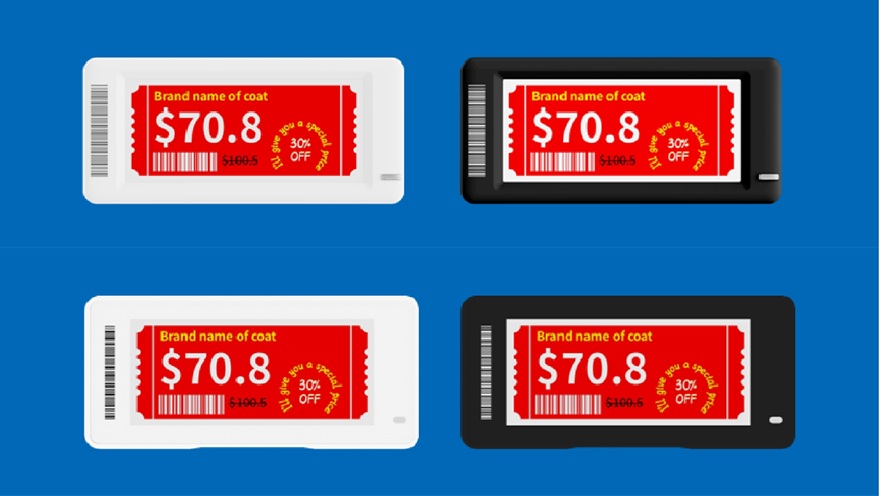
I don’t see much here, just an e-ink display with a tiny processor and presumably some sort of network connection. OK, the price fixing could happen via a larger in-shop surveillance network I guess.
I guess they blast the price data from the ceiling or something. No lan needed
Maybe they’re not yet tracking individuals through the isles by camera, but they can easily use demographic statistics to update those signs throughout the day.
They could also have a camera at the entrance to keep track of what kind of customers are in the store at any given time. They don’t need to have any data on individual customers, as long as their AI can estimate the characteristics of the people currently shopping. Or they can simply automatically raise the price of umbrellas only in the stores where it’s raining.
Yes yes yes. I was talking about the devices (digital pricetags) themselves though.
Yes those don’t generate any kind of data.
They’re programmed using a low power bluetooth mesh network.
This makes it possible to transfer a table of all prices to all shelves in one go. There’s no need to program or send data to them individually. There’s a limit to something like 30000 tags, which is enough for most stores.
The key is that they can automatically update the prices fast enough that it makes sense to do it. If a human had to do anything in this regard, it probably would not pay off to change the prices with pennies several times daily.