

7·
4 days agoYou don’t understand though, by being visionaries who disregard accepted margins of safety, they lowered the cost per (attempted) launch by almost 3%!
You don’t understand though, by being visionaries who disregard accepted margins of safety, they lowered the cost per (attempted) launch by almost 3%!

And the SM57 for things you don’t need a screen on.

With a bit of luck, native RTC support means 2-way comms using reolink doorbells is close at hand.

A discussion on the other site claimed that the fuck-up was in the copy that Universal sent to Mattel.
And that wrong websites frequently end up on packaging in other industries.
Mattel seem to be doing the sorry-dance for it, so no idea if it’s true. Though I’m sure Universal would be very keen to not be involved.
I once changed a friend’s autocorrect from “regards” to “lots of love”.
And I somehow managed to keep my mouth shut long enough for a lecturer to get a very funny email.

This is why I did a 180 on getting hives.
Honey is nice, but driving out the bumbles around here would be criminal.
I’ll just re-share mine from last time.
I tend to use the Horizontal Stack. On a mobile device, I just get one stack per line.
And on bigger screens, I get multiple stacks to make use of space.
General “Going out” page:

Internet speedtest page:
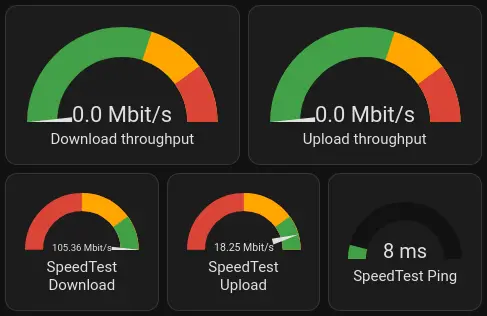
I’ll write a quick gist for anyone coming along:
One gas boiler in the house, each room has a smart TRV.
PIR sensor to set room presence, each window has an opening mag sensor.
HASS has a general presence sensor set.
Each room’s temperature is targeted based on presence and window status:
For each room, if person is home at all, and has been in the room for 5 mins, and the window is closed, TRV to 19, boiler on if <19.
If the room presence is negative and the window is closed, drop TRV target to 16.
If the window is open, drop the TRV target to 7.
There is a little more detail that that in the article, but that’s the basics.
Catwoman: What’s a hroom?

Awesome work, thankyou for taking the time to do this.
I too love a metal USB stick for the keychain, and my old DTSE9 could do with a refresh!
That doesn’t sound very typical.
z-wave may be easier than expected, as I think the devices stay linked to the hardware dongle used. (This is just from memory, mind!). But if you need to change the dongle, perhaps less fun.
imo, it will be a bit of pain to get everything inside HA, but once it’s done, you’ll be inside a platform that is pretty open, and commonly used, with lots of other people (hopefully) posting up solutions to problems before you encounter them!
And because it’s software that will run on pretty much anything, you have the reassurance that even if something crazy happened, you could just reinstall an old version.
If it were me, I’d clear an entire weekend day, power off the old kit, and work away at getting HA controlling everything.
Nice to see NC becoming involved with the board.
I don’t run that much z-wave due to cost, but I’m all for improvements and tighter integration.
Especially since when I do want to spend money, ZW works very well.
Must be the fracking residue in the water.
Or maybe something like this:
https://www.securemeters.com/uk/product/room-thermostats/hrt4-zw-asr/
The unit with the buttons on is a simple relay, which hass can control to turn things on and off, and use a heating control with a temperature sensor.
But if you hit the button on the front, it also gives 30 minutes of on, which can be handy if the system had issues.
Or you could have a hass controlled relay, but also leave the old controller wired in on a manual switch.
So if there was a failure, you could go back to the old control by manually flipping it over.

Or ignorance made a convenient fig leaf.
This is an absolutely brilliant summary.
It’s only Virgin Media to my knowledge who does this.
Most of the other providers are happy for you to use anything that works properly for VDSL or FTTP.
Most FTTP providers fit an ONT that puts the connection back into an RJ45 ethernet connector.
Then you connect to the provider using PPPOE. Anything past the ONT, you can do whatever you like.





2 days later, squiddy will be buying the books. Ideal christmas gift for your parents!