In our defence (spelt correctly) all of the above are acceptable, except the microwave. Reasons being that a) the microwave doesn’t boil it evenly, and you get pockets of mega heated water that bubble up and splash up in the microwave, then drip off the manky ceiling of the microwave and into your cup. B) microwaves stink. I don’t know anyone that uses one for anything other than popcorn or melting butter. But if you’re using it to cook as well… 🤢
Convection currents don’t stir water in a microwave because the heat source isn’t on the bottom. That’s the difference. You get temperature stratified water where the surface is hotter than the bottom of the cup and they don’t naturally mix.
Of course, here in America, we have this incredible technology called a spoon. Pull that bad boy out, give a little stir, problem solved.
I’m well aware of temperature stratification. It doesn’t happen in a microwave.
It empirically does. We can argue about the theory all day but the research says microwaves produce stratified temperature gradients when heating liquids. However, I’d point out that, in atmosphere, when we have localized hot spots the warm air can effectively travel in bubbles without significant mixing for quite some distance. There seems to be a similar phenomena at work when microwaving liquids.
See the screenshot below.
I pulled this from “Multiphysics analysis for unusual heat convection in microwave heating liquid” published in 2020 in AIP Advances.
Relevant excerpts:
“ Usually, the fluidity of liquids is considered to make the temperature field uniform, when it is heated, because of the heat convection, but there is something different when microwave heating. The temperature of the top is always the highest in the liquid when heated by microwaves.”
“ The experimental results show that when the modified glass cup with 7 cm metal coating is used to heat water in a microwave oven, the temperature difference between the upper and lower parts of the water is reduced from 7.8 °C to 0.5 °C.”
“According to the feedback from Midea (microwave appliance makers), when users use the microwave oven to heat liquids such as milk or water, the temperature at the top of the liquid will be significantly higher than the temperature at the bottom.”
That’s not really showing temperature stratification which is a more extreme separation of temperature from surface
I think the definition you are using is far too restrictive, in many contexts temperature stratification simply refers to a situation where you get temperature gradients across a fluid with the warmer fluid gathered near the top of the body. For example, in a factory you will often have “destratification” fans operating because warm air from equipment rising to the ceiling results in a temperature gradient from floor the ceiling.
It is not a phenomena exclusive to surface heating.
That’s just showing that the hottest atoms gather to the top, which btw, proves Convection currents.
Yes. My point was not to establish that convection is magically absent from fluids in microwaves, but to establish that it differs significantly from stovetop heating. Convection currents in stovetop heating create a strong stirring action that produces a substantially uniform temperature. Microwaves do not create the same stirring action and this produce a significant nonuniform temperature gradient.
The modified glass is just diverting the hotpots to the bottom to make the convection less “unusual”.
Clearly. They make the heating more akin to a stovetop, which is really the point here.
They aren’t claiming that convection doesn’t accrue, only that it’s “unusual convection” resulting in less even heating like that of thermal stratification, not literal thermal stratification where the layers have separate convection currents that prevent mixing all together.
Once again, you are using a definition of thermal stratification that is far too specific. However, arguing over it is really just being pedantic because the core point at issue here is whether or not heating a cup in a microwave or a stovetop produce the same final product. They do not unless you apply some mechanical agitation to mix it up.
You gotta clean the microwave regularly like anything else. There are reasons why I would probably use my stove top over my microwave to boil water (though I do use a microwave to make tea when I just want a single serving), but your points about water splashing up everywhere and dripping down off of disgusting interior surfaces of the microwave sound a lot like operator error.
I’m just imagining @Mr_Blott@lemmy.world microwaving a cup of water for way too long to absolutely volcanic results and then throwing up his hands in disgust before walking away from the swampy microwave without bothering to clean the mess up like a scene out of some infomercial for a device that solves microwave issues that don’t exist lol
Yeeeeah, that’s not how microwaved water works. If there IS any temperature differential, the movement of the water quickly evens it out. By the time you’re dropping your tea in, it’s even.
As far as microwaves being stinky, that’s a you thing, bud. My microwave smells fine.
Or just like gently stir the water when it comes out of the microwave. You’d really have to overcook the fuck out of the water to create a risk of superheated water explosions. Tea should be slightly below boiling anyway.


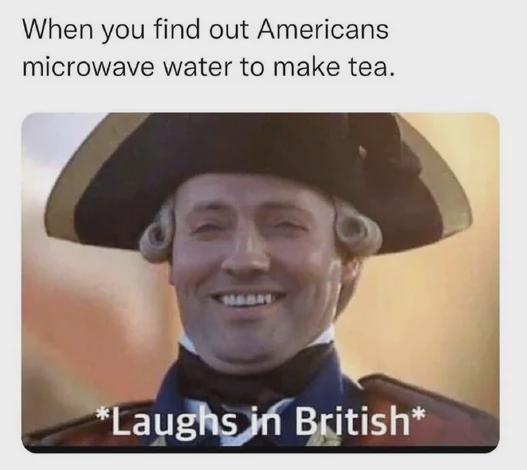
In our defence (spelt correctly) all of the above are acceptable, except the microwave. Reasons being that a) the microwave doesn’t boil it evenly, and you get pockets of mega heated water that bubble up and splash up in the microwave, then drip off the manky ceiling of the microwave and into your cup. B) microwaves stink. I don’t know anyone that uses one for anything other than popcorn or melting butter. But if you’re using it to cook as well… 🤢
deleted by creator
Convection currents don’t stir water in a microwave because the heat source isn’t on the bottom. That’s the difference. You get temperature stratified water where the surface is hotter than the bottom of the cup and they don’t naturally mix.
Of course, here in America, we have this incredible technology called a spoon. Pull that bad boy out, give a little stir, problem solved.
deleted by creator
deleted by creator
I mean, it’s not really a matter of debate TBH. There are a number of peer reviewed journal articles documenting the temperature stratification. Here is one source, where the authors attempt to create a special cup to heat the water more evenly.
deleted by creator
It empirically does. We can argue about the theory all day but the research says microwaves produce stratified temperature gradients when heating liquids. However, I’d point out that, in atmosphere, when we have localized hot spots the warm air can effectively travel in bubbles without significant mixing for quite some distance. There seems to be a similar phenomena at work when microwaving liquids.
See the screenshot below.
I pulled this from “Multiphysics analysis for unusual heat convection in microwave heating liquid” published in 2020 in AIP Advances.
Relevant excerpts:
“ Usually, the fluidity of liquids is considered to make the temperature field uniform, when it is heated, because of the heat convection, but there is something different when microwave heating. The temperature of the top is always the highest in the liquid when heated by microwaves.”
“ The experimental results show that when the modified glass cup with 7 cm metal coating is used to heat water in a microwave oven, the temperature difference between the upper and lower parts of the water is reduced from 7.8 °C to 0.5 °C.”
“According to the feedback from Midea (microwave appliance makers), when users use the microwave oven to heat liquids such as milk or water, the temperature at the top of the liquid will be significantly higher than the temperature at the bottom.”
deleted by creator
I think the definition you are using is far too restrictive, in many contexts temperature stratification simply refers to a situation where you get temperature gradients across a fluid with the warmer fluid gathered near the top of the body. For example, in a factory you will often have “destratification” fans operating because warm air from equipment rising to the ceiling results in a temperature gradient from floor the ceiling.
It is not a phenomena exclusive to surface heating.
Yes. My point was not to establish that convection is magically absent from fluids in microwaves, but to establish that it differs significantly from stovetop heating. Convection currents in stovetop heating create a strong stirring action that produces a substantially uniform temperature. Microwaves do not create the same stirring action and this produce a significant nonuniform temperature gradient.
Clearly. They make the heating more akin to a stovetop, which is really the point here.
Once again, you are using a definition of thermal stratification that is far too specific. However, arguing over it is really just being pedantic because the core point at issue here is whether or not heating a cup in a microwave or a stovetop produce the same final product. They do not unless you apply some mechanical agitation to mix it up.
You gotta clean the microwave regularly like anything else. There are reasons why I would probably use my stove top over my microwave to boil water (though I do use a microwave to make tea when I just want a single serving), but your points about water splashing up everywhere and dripping down off of disgusting interior surfaces of the microwave sound a lot like operator error.
deleted by creator
I’m just imagining @Mr_Blott@lemmy.world microwaving a cup of water for way too long to absolutely volcanic results and then throwing up his hands in disgust before walking away from the swampy microwave without bothering to clean the mess up like a scene out of some infomercial for a device that solves microwave issues that don’t exist lol
Like I ever microwaved a cup of water 😂 I’m not a fucking barbarian lmao
Yeeeeah, that’s not how microwaved water works. If there IS any temperature differential, the movement of the water quickly evens it out. By the time you’re dropping your tea in, it’s even.
As far as microwaves being stinky, that’s a you thing, bud. My microwave smells fine.
Really the only danger in using a microwave to boil water is superheating if there are no nucleation sites in the mug.
Which is why it’s important to put the teabag in the water before microwaving it.
Or just like gently stir the water when it comes out of the microwave. You’d really have to overcook the fuck out of the water to create a risk of superheated water explosions. Tea should be slightly below boiling anyway.
I know you are trying to bait me and I’m not going to fall for it
I thought tap water had enough particulate in it by itself?
Usually it does, but then again there are places where people don’t drink the tap water.
Just go the whole hog: put the teabag in the bottle of water and microwave that.